
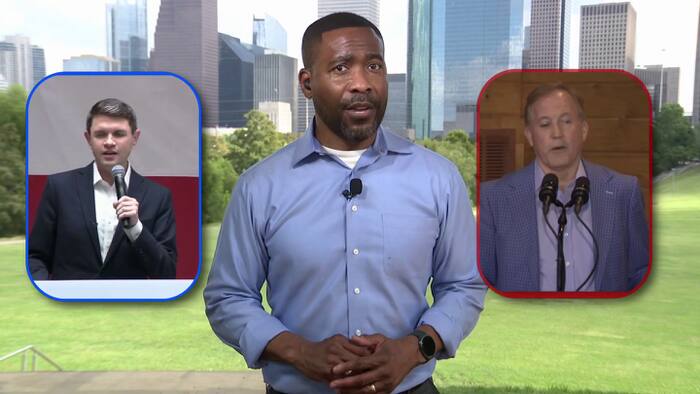
For decades, Texas has been a Republican stronghold. As we approach the November election, we’re hearing from voters who say their biggest concerns aren’t necessarily about Republicans or Democrats. They’re about what’s happening in their own communities, how much it costs to support their families and whether elected leaders are listening.
That frustration is playing out in Sealy, where residents are fighting a proposed 285-megawatt data center development.
Chad Welty says the opposition goes well beyond his community.
“It’s that big a deal. People are mad. And it’s not just here where we are. It’s all over. I’ve been able to travel all over Texas and people are mad everywhere. Everywhere I go you hear the same stories, people just feel like they’re being bulldozed over,” Welty said.
For some voters, those concerns are changing how they think about the November election.
Lisa Hicks, a longtime Republican who also opposes the proposed data center, says party affiliation matters less to her this year. She’s looking for candidates who will protect the interests of her community.
“If people just realized the power they hold, we could change this world, we could change the outcomes and see what we want to see, not put up with what we get!” Hicks said.
When we asked whether that power could come at the ballot box in November, she responded, “Some of it. Some of it very well could be, yes, absolutely.”
Texas Democrats have spent decades trying to win back statewide offices.
No Democrat has won a statewide election in Texas since 1994. Republicans have controlled every branch of state government since 2003.
Wendy Davis, Beto O’Rourke and Colin Allred are among the Democrats who have tried unsuccessfully to break that Republican hold.
Houston-area conservative activist Natalie Arceneaux believes that history is unlikely to change anytime soon.
“In the foreseeable future, I think it will remain solidly red,” Arceneaux said.
She argues Democrats have struggled to connect with the voters they need to win statewide.
“I just don’t think they have the message or ideology that resonates with the electorate. I mean you’re talking about working class people, again, who need to put food on the table, take care of their families,” Arceneaux said.
But those are the same voters Texas Democrats say they’re working to reach.
With inflation and the cost of living weighing on families, Texas Democratic Party Chair Kendall Scudder says his party is focused on working-class Texans who feel their concerns have been ignored.
Scudder says Democrats have also spent the past 18 months strengthening their organization across the state, something he believes has been missing in previous elections.
“We’re building a coalition of working class people in 254 counties standing up to take this state back. And when we do, it’s gonna take all of us to hold those democrats accountable and make sure they’re delivering,” Scudder said.
Building support is one thing. Turning that support into statewide victories is another.
Rice University political analyst Dr. Mark Jones says Texas Democrats face a challenge that extends beyond their own candidates and campaigns.
He says Republicans have successfully linked Texas Democrats to more liberal policies supported by national Democratic leaders in states such as California and New York.
That association, Jones says, can make it harder for Texas Democrats to appeal to moderate voters.
This year’s election could test whether those political dynamics are changing.
Democrat James Talarico is running a competitive U.S. Senate race against Republican Ken Paxton. Talarico has emphasized economic divisions, arguing that the biggest divide isn’t between the political left and right, but between those at the top and everyone else.
The governor’s race between Republican incumbent Greg Abbott and Democratic state Rep. Gina Hinojosa has also been close in polling.
Still, Jones cautions that competitive races don’t necessarily mean Texas is undergoing a fundamental political shift.
He points to the national political environment and the candidates themselves as factors that could influence the outcome.
“You have a very unpopular Republican president in the White House who’s dragging down Republican candidates from Alaska to Texas to Maine,” Jones said.
He also described Paxton as a particularly vulnerable statewide Republican candidate.
So, is Texas actually changing politically? Or are we seeing a competitive election year in a state that hasn’t fundamentally changed?
We won’t know the answer from one poll or even one race.
What Texas voters decide in November will give us another piece of the answer.


