
What are journalists missing from the state of Delaware? What would you most like WHYY News to cover? Let us know.
A member of Delaware Gov. Matt Meyer’s administration expressed reluctance to openly give her views on the state’s unclaimed property program at the first meeting of a legislative taskforce last week.
Open government advocates and those familiar with Delaware’s unclaimed property program said they’re concerned those in the industry might prefer fewer public conversations about the program because of all of the revenue going into the state coffers and its third-party vendors.
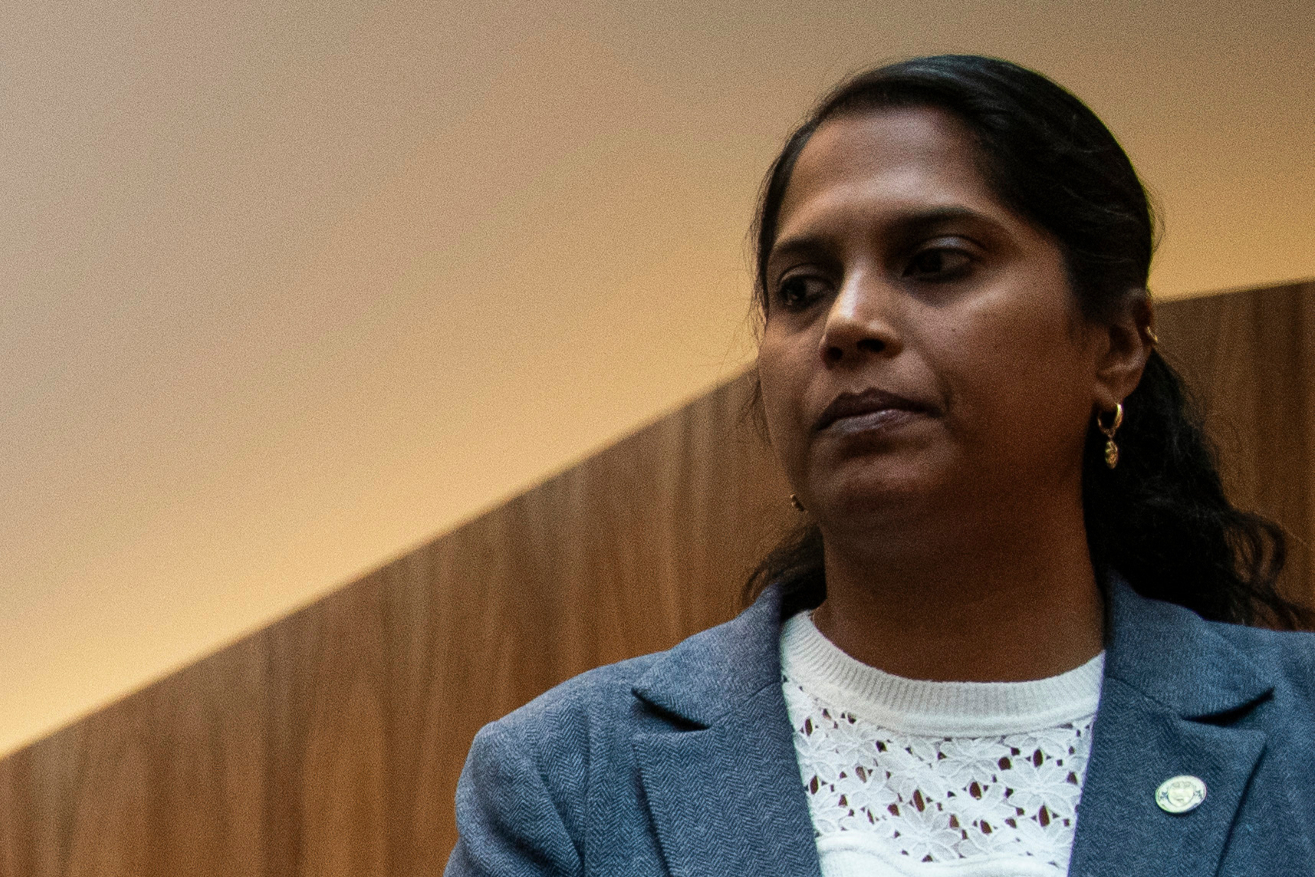
Delaware Secretary of State Charuni Patibanda-Sanchez’s request to go behind doors without citing a legal justification, has sparked fears that state lawmakers and members of Meyers’ administration will seek to weaponize the state’s open meetings law to secretly discuss how the state collects and uses its third-largest revenue source.
When asked about the legal justification for her request under Delaware’s Freedom of Information Act, a spokesperson for Patibanda-Sanchez said in an email that they had “no response.”
“You just can’t arbitrarily say, ‘I want to go into executive session,’” said John Flaherty, spokesperson for the Delaware Coalition for Open Government. “You have to cite exactly what section of the law triggers the executive session request. I think she needs to maybe bone up on the open meeting law.”
Senate Majority Leader Bryan Townsend, who co-chairs the task force, said previous administrations also tried to prevent public discussions of the program’s inner workings, such as during Gov. Jack Markell’s tenure, when a similar legislative taskforce met in 2014.
“I fondly recall in 2013 being approached in the hallway downstairs,” Townsend said. “One could even maybe say accosted by representatives of the office of the governor who thought that this should not be a topic that was looked at for a variety of reasons that one could very fairly say apply even now.”
Still, a spokesperson for Townsend, who is working on a bill to increase government transparency, said the task force could legally go behind closed doors to discuss pending or potential litigation. The law says that is only allowed when an open meeting would have an adverse effect on the litigation position of the public body.
Flaherty said Townsend needs to defend the public’s right to know if he is serious about revamping FOIA.
“That’s crazy,” Flaherty said. “Secrecy doesn’t solve anything. It just engenders a lot of suspicion.”


