
Earlier this week, I listened to my friend and colleague Emily Gracey’s podcast, Atmosphere. I enjoy her podcast because she explores weather and science from a unique perspective, and I always come away having learned something new.
This week’s episode, Daylight Saving Time: The Great Debate, shared some fascinating information I hadn’t heard before. Today, I want to pass some of that along to you.
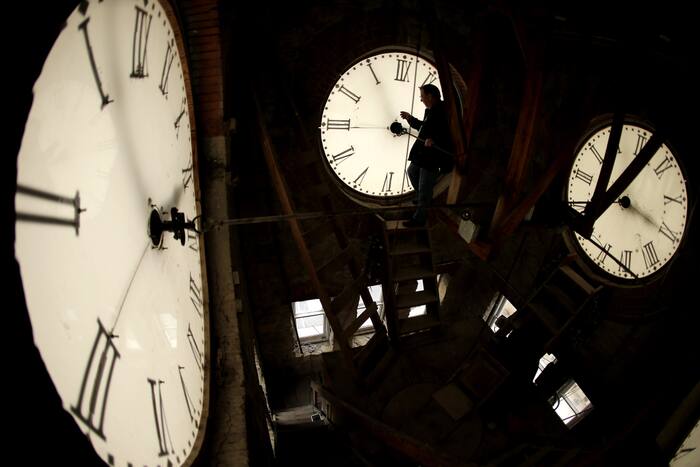
But first, a quick reminder: Daylight Saving Time ends this weekend, so don’t forget to turn your clocks back one hour. At 2 a.m. Sunday, the clocks roll back to 1 a.m., giving us that familiar “extra” hour of sleep.
Here’s how sunrise and sunset times will change in Houston from Saturday to Sunday.

With Election Day coming up Tuesday, let’s start with the politics of the time change.
Congress passed the Sunshine Protection Act, a bill that would make Daylight Saving Time permanent. But the legislation stalled in the Senate and never became law.
I put together a video explaining the history of Daylight Saving Time, how we got to where we are today, and the government’s efforts to keep us on Daylight Saving Time year-round.
Below is my Instagram video.

In her podcast, Gracey interviewed Dr. Jamie Zeitzer, a sleep researcher at Stanford University, professor of psychiatry and behavioral sciences, and co-director of the Center for Sleep and Circadian Sciences.

Dr. Zeitzer studies how light affects our internal body clocks, sleep and overall health. What I liked about Emily’s approach was that she moved beyond the debate over what we should do with our clocks and focused on a more important question: What is healthiest for us?
Imagine going back to the 1800s, when a town square clock helped everyone keep time. Our schedules would follow the sun, with daylight guiding when we worked, slept and played. That might be a more natural way to live, but our modern world this past life is impossible.
Dr. Zeitzer argues that if we settle on one time year-round, Standard Time is the healthier choice compared with permanent Daylight Saving Time.
Why? Our bodies are designed to respond to the natural light-dark cycle. Standard Time generally aligns our daily schedules more closely with the sun, giving us more morning light and helping our internal clocks stay in sync.
Where you live and how you structure your day also matter, but the timing of sunlight plays a big role in our sleep and health.
When I asked this question on Facebook, many of the responses favored Standard Time, too. It’s an interesting debate, especially when you consider that what feels convenient for our schedules isn’t necessarily what works best for our bodies.

Here’s something I didn’t know. When we talk about our circadian rhythm, we’re talking about a biological system controlled by a real part in our brain.
It’s called the suprachiasmatic nucleus, or SCN. This tiny cluster of neurons acts as our body’s central clock, helping regulate our roughly 24-hour rhythms, including when we feel sleepy and when we’re alert.
Light is one of the most important signals that keeps this clock synchronized with the world around us. When we suddenly shift our clocks by an hour, our social schedules change overnight, but our internal clocks don’t necessarily adjust as quickly.
That’s one reason the time change can leave us feeling out of sync.
The biggest takeaway for me was simple: Get outside and spend more time in natural daylight.
Morning light, in particular, helps signal to your brain that it’s time to be awake and can help keep your circadian rhythm on track. Getting outside regularly is a simple way to support healthy sleep and your body’s natural rhythms.
We can debate Standard Time versus Daylight Saving Time, but getting more natural light is something most of us can work into our daily routines regardless of what the clocks show.

These are just a few highlights from Emily’s podcast, and I encourage you to listen to the full episode. I promise you’ll learn something new.
One fact that really caught my attention: China has just one official time zone for the entire country!
Think about how large China is and how different sunrise and sunset times must be from one end of the country to the other. Rather than using multiple time zones, people in different regions adjust their daily schedules, including work and school start times.
It made me wonder: How would that work in the United States?
There’s one more thing Dr. Zeitzer pointed out that I found interesting: If we’re going to change our clocks, this weekend’s change is the healthier one.
When we “fall back,” we gain an hour on the clock, which can give us an opportunity to get more sleep. In the spring, we do the opposite. We lose an hour, and that sudden shift can disrupt our sleep and throw our internal body clocks out of sync.
Of course, that extra hour doesn’t automatically mean everyone will get an extra hour of sleep. But the fall transition is generally easier on our bodies than the spring transition.
So, when you turn your clocks back Saturday night, enjoy that extra hour. Your body will appreciate it.

If you listen to the episode, I’d love to hear what you think. Should we keep changing our clocks, stick with Standard Time year-round, or make Daylight Saving Time permanent? And after hearing the science, would your answer change?


