
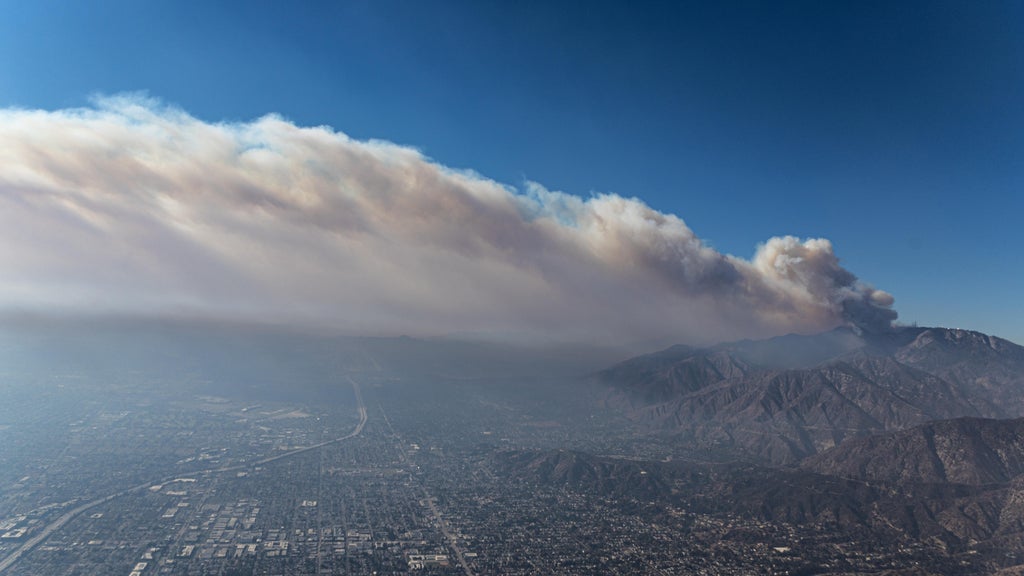
A new study from Caltech found that millions of Los Angeles County residents were exposed to elevated concentrations of lead and other toxic metals from smoke created by the Eaton Fire last year.
According to the study, published in Science Advances journal, researchers estimated that when the Eaton Fire was at its peak of structural burning, about 7 million people in LA's metropolitan area were exposed to 24-hour lead concentrations 80 times higher than typical values.
Scientists said the smoke generated by the devastating fire, which killed 19 people, burned more than 14,000 acres and destroyed nearly 10,000 homes, had a "very different chemical nature" when compared to smoke from a typical wildfire. The report is among the first to characterize the air that residents might be breathing during urban fires, according to Caltech.
"In the early stages of the fire, when many structures and vehicles were burning, the concentration of toxic metals in the atmosphere spiked dramatically," Caltech's report said. "This chemical signature, which was measured by an advanced air monitoring station located downwind of the fire, then evolved as the blaze moved from urban areas up into the mountains above Altadena, part of the Angeles National Forest."
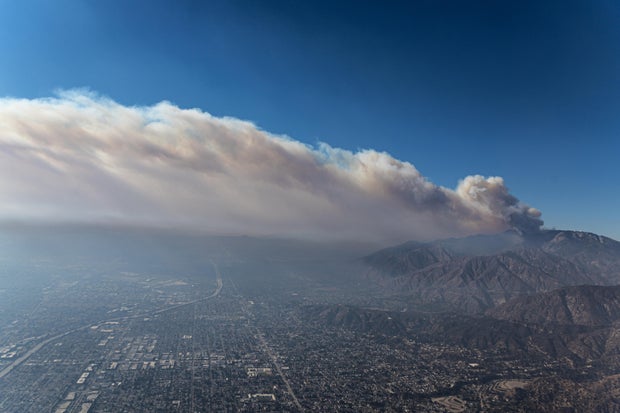
Researchers said that the urban plume of smoke was enriched more than 50-fold in lead, 7-fold in chlorine and bromine and 3-fold in arsenic, based on data gathered from an air-monitoring station in Pico Rivera, which is approximately 11 miles south of Altadena.
"Urban fire plumes are chemically distinct from those of wildfires. Now that we have these observational data about how they differ, we can go back and adjust our models to more accurately estimate how smoke might affect people," said Haroula Baliaka, the lead author of the Caltech study. "Smoke travels; it's not just about the burn area. What does a plume mean for people who are miles away from a fire but receive the smoke? We evacuate for fire, but we don't evacuate for smoke exposure."
Baliaka co-authored the report with Caltech graduate student Ryan Ward. They both monitored the plume from the Pico Rivera station by using four instruments that continuously measured the chemistry and physical properties of the airborne particles.
The air monitoring station is also one of 12 across the United States that make up the National Science Foundation's Atmospheric Science and Chemistry mEasurement NeTwork, or ASCENT, the Caltech release said. Because ASCENT stations run continuously, researchers were able to observe the changing chemical nature of the smoke plume as it moved from the urban area and into the San Gabriel Mountains.
Scientists then compared the data from the Eaton Fire and the 2024 Airport Fire, which burned nearly 24,000 acres in Orange and Riverside counties.
"Essentially, this comparison between the two fires indicates how different and chemically distinct an urban fire is," Baliaka said, adding that while that "might seem intuitive," there is a lack of data about chemicals in smoke from urban fires.
The report showed that lead levels spiked in eastern LA and the San Gabriel Valley on January 8 and 9, with the highest readings detected downwind of Altadena. As the fire moved from the city and into the mountains, approaching typical wildfire levels by January 11, the potassium ratio in the plume increased, while the lead levels decreased.
Researchers said that a goal moving forward is to use the data they gathered to update models that predict air quality and the amount of pollutants that could be released from urban fires and wildfires. Caltech Professor of Chemical Engineering and Environmental Science and Engineering Richard Flagan was a contributor to the report, adding that the response to the Eaton Fire and to the contamination of debris left in its wake were predicated on the firestorm being a wildfire event.
"But the Eaton Fire was an extreme urban fire event," he said. "Perhaps it is time to reconsider fire codes to address the possibility of urban firestorms in densely populated urban areas, and consider the downwind health impacts and excess mortality as the important impacts of such events."
The report notes that the strong lead levels detected could be unique to the Eaton Fire due to the amount of older homes and structures that burned in Altadena. In April 2025, Pasadena city leaders issued a public health advisory after the first soil tests from the Eaton Fire burn zone found lead levels exceeding federal screening guidelines. The Environmental Protection Agency also began testing soil from dozens of homes in early 2026.
A University of California study released in June detailed that more than 3 million people downwind of the Palisades and Eaton fires may have been exposed to a toxic carcinogen called chromium-6, which is a metal commonly associated with asthma, bronchitis and lung cancer.


